
The Rose Dorothea Schooner at Provincetown Public Library
Tucked inside one of Provincetown’s most unexpected spaces, the Rose Dorothea schooner model stands as a striking tribute to the town’s maritime legacy. Positioned dramatically within the former church that now houses the Provincetown Public Library, this half-scale replica is more than an exhibit, it’s a powerful reminder of the courage, craftsmanship, and community that defined Provincetown’s fishing era.
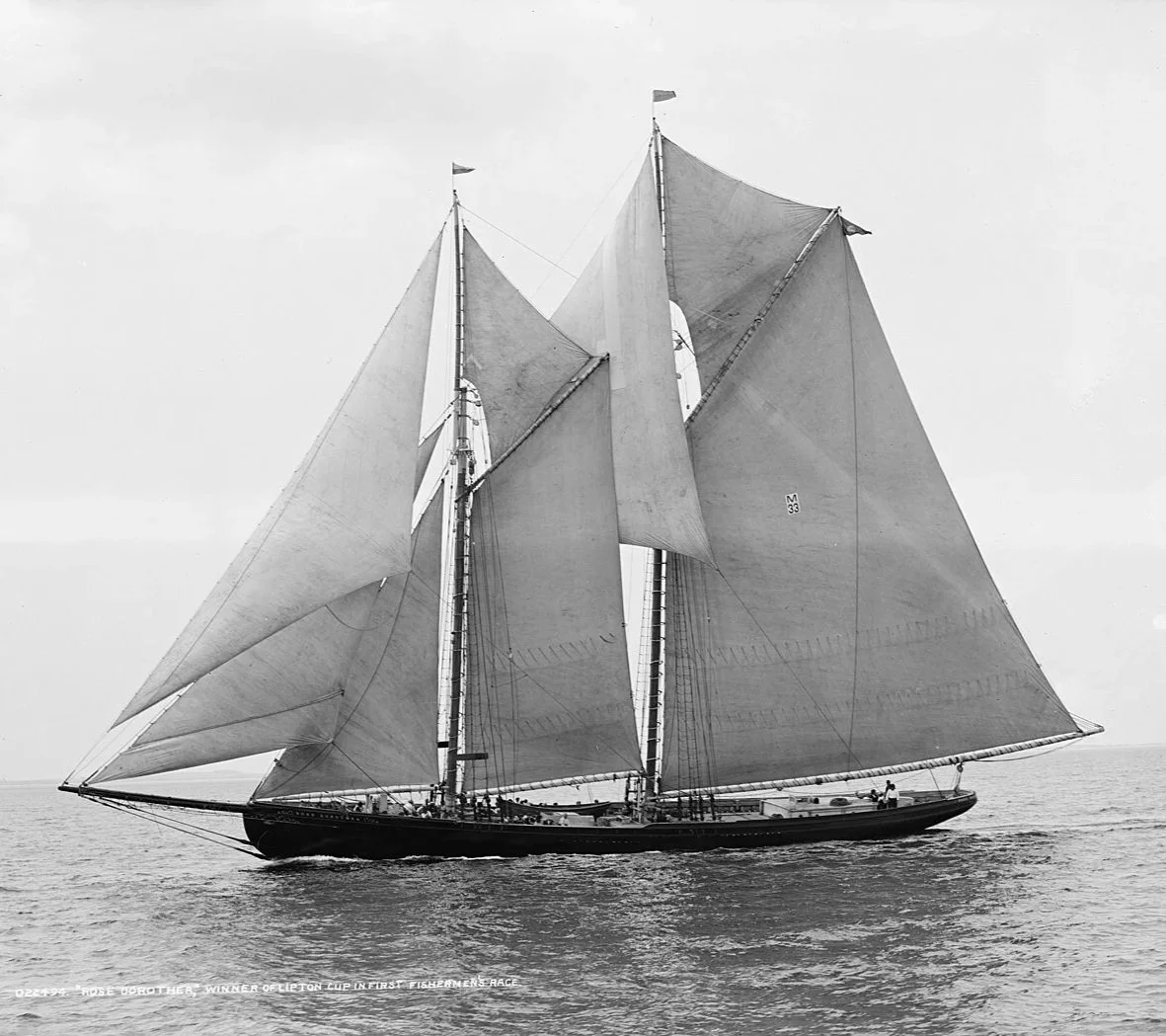
A Champion of the Sea
The original Rose Dorothea was built in 1905 in Essex, Massachusetts, designed by renowned shipbuilder Thomas McManus. She was engineered for speed and performance, with a distinctive rounded bow that allowed her to sail closer to the wind than many of her competitors.
Her place in history was cemented during the 1907 Lipton Cup Fishermen’s Race, a demanding 42-mile course through Massachusetts Bay. Representing Provincetown, the Rose Dorothea faced off against rival schooners, including the Jessie Costa. Despite suffering damage, losing her fore-topmast during the final leg, she pushed forward under the leadership of Captain Marion Perry and race skipper John Watson to secure a dramatic victory.
When she returned home on August 1, 1907, Provincetown celebrated in full force. A broom tied to her mast symbolized a “clean sweep,” marking not just a race win, but a moment of pride for the entire community. Notably, the Lipton Cup was never raced for again, securing the Rose Dorothea’s legacy permanently in history.
From Working Vessel to Lasting Tribute
By the late 20th century, Provincetown sought a way to honor its rich fishing heritage. In 1977, a dedicated group of local volunteers, began constructing a half-scale replica of the Rose Dorothea inside what was then the Heritage Museum.
After more than a decade of craftsmanship, the model was completed and officially dedicated in 1988. Measuring over 66 feet in length, the schooner fills the interior of the building with remarkable presence, its masts and rigging stretching upward toward the vaulted ceiling.
Today, the ship remains one of the most unique indoor maritime exhibits in the country, blending history, artistry, and architecture in a single unforgettable space.

A Living Piece of Provincetown’s Identity
The schooner is more than a visual centerpiece, it tells the story of the fishermen who once defined Provincetown’s economy and culture. The crew of the Rose Dorothea, many of whom were Portuguese immigrants, reflect the deep-rooted heritage that continues to shape the town today.
Standing beneath the vessel, visitors gain a tangible sense of scale and respect for the lives lived at sea. It’s a rare opportunity to connect directly with the grit and determination that built Provincetown into the community it is now.
Why You Should Visit
Whether you’re a history enthusiast, a first-time visitor, or a longtime resident, the Rose Dorothea is a must-see:
Unexpected setting: A full schooner inside a library creates a memorable experience unlike any other
Local heritage: A direct connection to Provincetown’s fishing and shipbuilding past
Architectural beauty: The contrast between the ship and the former church interior is visually stunning
Free and accessible: Open to the public as part of the library experience
Final Thoughts
The Rose Dorothea is not just a model, it’s a symbol of Provincetown’s resilience, innovation, and pride. It captures a moment in time when the town’s identity was shaped by the sea, and preserves it for future generations in a way that feels both intimate and grand.
If you find yourself walking along Commercial Street, step inside the Provincetown Public Library. Look up and you’ll find one of Provincetown’s most meaningful and unexpected treasures.
Explore more of Provincetown: Provincetown Public Library, Provincetown’s East End, Cannery Wharf Park
The Rose Dorothea Photograph. Library of Congress, Prints & Photographs Division, Detroit Publishing Company Collection, Call Number: LC-D4-22494. Gift; State Historical Society of Colorado; 1949. Provincetown Public Library